
Written by Fabiola Perales, Ph.D. in public policy, specializing in better regulation policy, fabiola.perales@mejoresgobiernos.org
I. Introduction
In July 2025, Mexico abandoned the Better Regulation Policy’s name and model (also known as Regulatory Improvement Policy), which had been in place since 1989 and institutionalized in 2000. In the middle of last year, the General Law on Regulatory Improvement and all local regulatory improvement systems were repealed, and the National Commission for Regulatory Improvement (CONAMER), the body responsible for that policy, was eliminated from the Federal Public Administration.
In its place, the National Law to Eliminate Bureaucratic Procedures (LNETB) was enacted, the name of the regulatory improvement policy was changed to the policy of simplification and digitization, and its functions were transferred to the General Directorate of Administrative Simplification within a new agency called the Agency for Digital Transformation and Telecommunications (ATDT by its acronym in Spanish).
President Claudia Sheinbaum’s administration aims to mark a turning point in this area and is replacing not only the legal and institutional framework but also the technological tools. The following table provides a brief overview of the platforms we previously knew and the new ones that have been created:
Table 1. Technological Tools for Regulatory Improvement
|
Platforms |
Platform name before the 2025 reform |
Platform name after the 2025 reform |
Current access (May 2026) |
Comment |
|
Regulatory review platform |
MIR or AIR system |
Comprehensive regulatory governance platform |
Major change. Completely new. |
|
|
Platform for procedures, regulations, and inspections |
National Catalog of Regulations, Procedures, and Services and Inspections |
National Catalog of Regulations, Procedures, and Inspections |
It remains, but the sections related to procedures (federal and local) have been removed. |
|
|
Procedure Inventory Platform |
Register of Federal and Local Procedures and Services |
Single Citizen Portal for Procedures and Services |
Remains; contains only federal procedures. |
Source: own elaboration
II. The Big Change: The AIR Platform
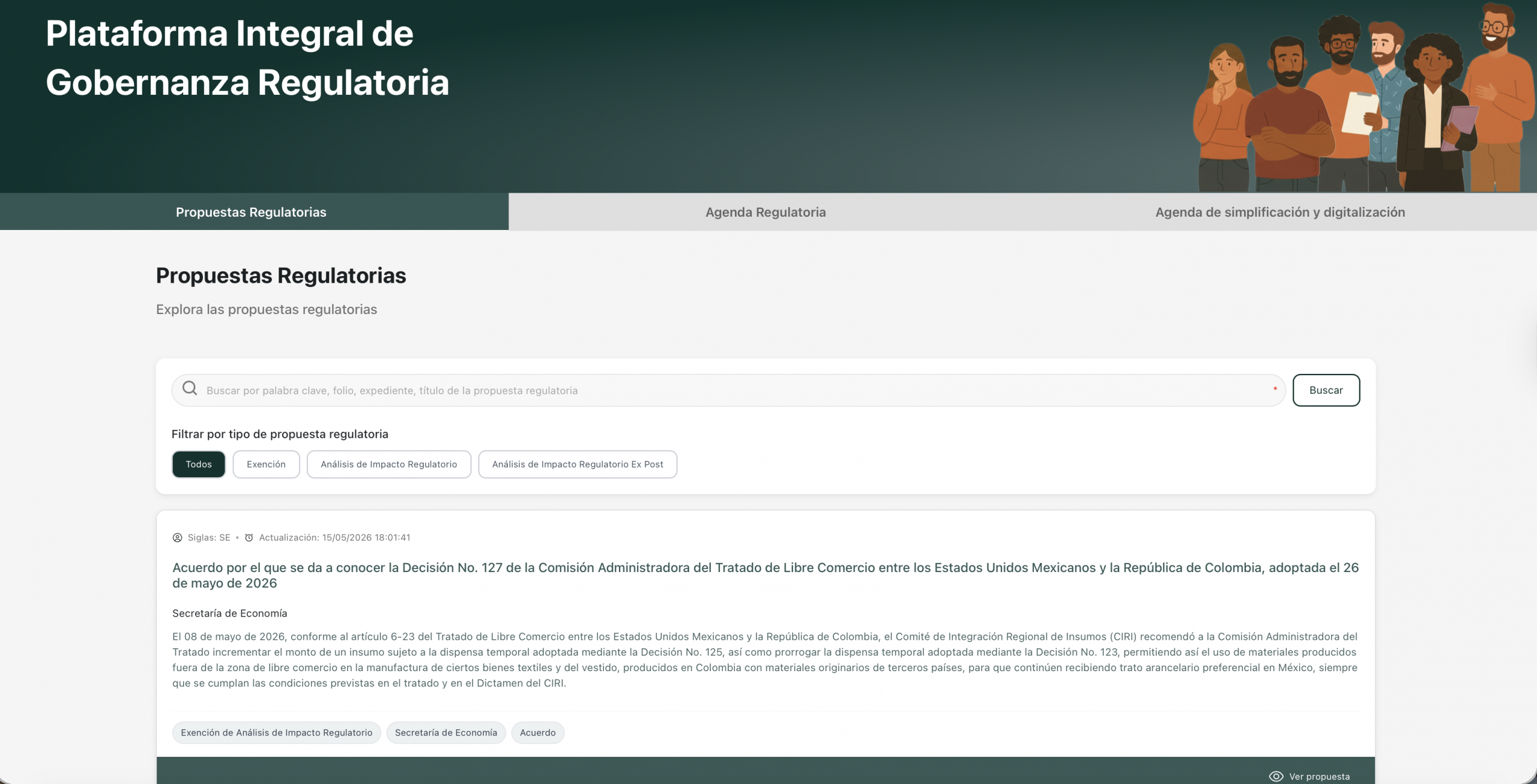
México ya cuenta con una nueva plataforma de revisión regulatoria. La nueva plataforma se denomina “Plataforma integral de Gobernanza Regulatoria”.
https://www.herramientasregulatorias.gob.mx/Buscador
This platform brings together three types of regulatory reviews, which are:
- The analysis and public consultation of regulations to be issued (ex ante AIR)
- Analysis of regulatory agendas and agendas for simplification and digitization
- Analysis of ex post evaluations (ex post RIA)
To provide a brief overview of the new platform, a comparative analysis between the old and new platforms is presented below.
Table 2. A comparative analysis of regulatory review platforms in Mexico
|
Analysis category |
Regulatory Impact Statement System (SIMIR) |
Regulatory Governance Platform |
|
Website |
||
|
Operator |
It was first operated by the Federal Commission for Regulatory Improvement (COFEMER), and later by the National Commission for Regulatory Improvement (CONAMER) |
Agency for Digital Transformation and Telecommunications (ATDT) |
|
Current Status |
Inactive |
Active and official platform |
|
Migration date |
It ceased to be active on February 4, 2026. |
Replaces the previous system as of February 4, 2026 |
|
Main purpose |
Focused on the processes of:
|
Focused on the processes of:
|
|
Features |
Allowed users to search for regulatory files by government sector or keyword
It integrated electronic files for each regulatory proposal
Each file contained the regulatory proposal, its corresponding AIR form, CONAMER’s responses, and comments from the public
It allowed for the submission of comments from the public (public consultation) in all cases
It contained files dating back to the commission’s inception, thereby creating a historical record of regulatory issues
It allowed users to download the complete AIR document in PDF format
Notification bulletins regarding regulatory proposals. |
It allows users to search regulatory files by keyword only (not by sector)
It is organized by electronic files for each regulatory proposal or by type of agenda
In the case of AIRs, each file contains the regulatory proposal, its corresponding AIR form, the ATDT’s resolution, and comments from the public
In cases of AIR exemption, it does not display the ATDT’s resolutions nor does it allow comments from the public
In the case of agendas, they contain proposals for regulation, simplification, or digitization; comments may be submitted only during a specific time period, and they do not contain the ATDT’s resolution
AIR information is fragmented; it cannot be downloaded as a single PDF file |
|
Access to historical data |
It retained historical records from 2000 to 2025. |
As of today, there is no evidence of electronic file migration prior to the 2025 reform. |
Source: own elaboration
The new platform has seen little interaction and few comment, after three months of operation. However, this platform is highly relevant to the regulatory management system and for citizens and stakeholders: it is practically the last formal means for citizens and stakeholders to convey their concerns, suggestions, and relevant information to regulatory authorities to facilitate regulatory compliance and the creation of efficient regulations; therefore, it is important to publicize its relaunch and its existence.
III. The Regulatory Governance Platform’s Opportunity Areas
Furthermore, although the new platform is comprehensive—bringing together three regulatory analysis tools in a single virtual space—it presents areas for improvement, which are outlined below as recommendations:
-
Allow public comments on AIR exemptions. This functionality is essential. Citizens and businesses could alert authorities to potential bureaucratic costs, unnecessary procedures, or unintended impacts arising from regulatory proposals. Furthermore, it would allow for the collection of valuable information from the public and the business sector, such as identifying ambiguities, drafting errors, unintended effects, and better regulatory or non-regulatory alternatives. Currently, by excluding exemptions from this mechanism, the vast majority of regulatory initiatives are left without public scrutiny.
-
Publish the ATDT’s resolutions on RIA exemptions. Currently, the platform does not include this information. However, its relevance is critical: according to the ATDT’s 2025 Regulatory Impact Analysis Report, 94% of the regulatory proposals analyzed were RIA exemptions. The absence of an explicit review by the ATDT and the inability to receive comments mean that most federal regulations escape real oversight.
-
Incorporate the ATDT’s opinions and resolutions on regulatory agendas and on simplification and digitization agendas. The ATDT has the legal authority and obligation to issue opinions on these instruments. Keeping this information out of the public domain unnecessarily expands discretion and reduces accountability in defining the government’s regulatory priorities.
-
Substantially improve the search engine and filters for case files. The current search engine is basic. Although the volume of files remains manageable, considerable growth is expected in the medium and long term. Therefore, it is essential to implement an advanced search engine with filters for topic, agency, date, instrument type, process stage, keywords, estimated impact, and other relevant aspects, enabling efficient searches for the public.
-
Generate and publish open data from regulatory files and agendas. The systematic analysis and review of proposals are fundamental to improving the quality of regulatory governance. However, the lack of open data has made it difficult for academics, think tanks, and independent analysts to conduct rigorous studies. Publishing these datasets in open formats (such as CSV) would represent a significant leap forward in transparency and enable evidence-based decision-making to improve policy itself.
-
Establish a comprehensive historical record of regulatory reviews (2000–2025). Although the platform and the institution in charge have changed names, it is strategic to preserve and make publicly available the historical records of COFEMER/CONAMER. Understanding previous regulatory designs, their justifications, the comments received, and subsequent outcomes is valuable for avoiding the repetition of mistakes, conducting comparative analyses, and studying the evolution of Mexican regulatory policy.
-
Implement personalized notifications. Allow users (citizens, businesses, academics) to subscribe by topic, agency, or keyword and receive alerts when new proposals or relevant updates are published. This would significantly increase participation. The Cofemersimir system already had this functionality.
-
Incorporate AI-assisted analysis tools. In the age of AI, the ATDT could incorporate AI tools that allow, among other things, the generation of automatic summaries of regulatory files, the identification of potential risks of regulatory duplication, automatic comparison with similar regulations from the past or from other countries, and the summarization of received comments, among other possibilities.
-
Publish a record of how regulators address comments from the public. The ability to submit comments is important, but the response and attention given to them are even more important. How do regulators address comments? How do regulators incorporate suggestions or insights from the public into regulatory proposals? Submitting comments and not knowing what the authority did with that information undermines trust in the process, the platform, and the authorities; therefore, the ATDT could incorporate a feature that clearly shows which comments were received, which were incorporated into the regulatory proposal, how and why, and which were not and why. This builds trust and demonstrates that citizen participation truly influences decisions.
-
Allow the download of complete regulatory files in PDF format. Sometimes, platforms may fail, or citizens do not always have internet connectivity. Allowing the download of files in PDF format would be useful for individuals, as it facilitates their review, analysis, and safekeeping.
Adopting these improvements would enable the platform to serve as an information repository and take a step toward becoming a collaborative and transparent regulatory governance tool, aligned with OECD international standards and the expectations of an increasingly demanding public.
Finally, regardless of whether or not the ATDT makes any adjustments, it is important for academics, the general public, business associations, and business leaders to familiarize themselves with the platform, engage with it, and participate in the public consultation processes.
Let’s spread the word!
Como citar este texto:
Perales, F. (2026). Mexico’s New Regulatory Review Platform: What’s Changing and Why Does It Matter?. Blog Mejores Gobiernos.